

Organisations are frequently told that personnel working around water require a “DEFRA course” or “DEFRA Module 2.” However, the correct training depends on what those personnel are actually expected to do.
An employee inspecting a structure beside a river does not perform the same role as someone entering shallow water, supporting operations during flooding or responding as a member of a rescue team.
ISAR3 delivers both Rescue 3 industrial water-safety courses and DEFRA-aligned water and flood-response training. We will help you identify the appropriate level rather than automatically recommending the highest qualification.
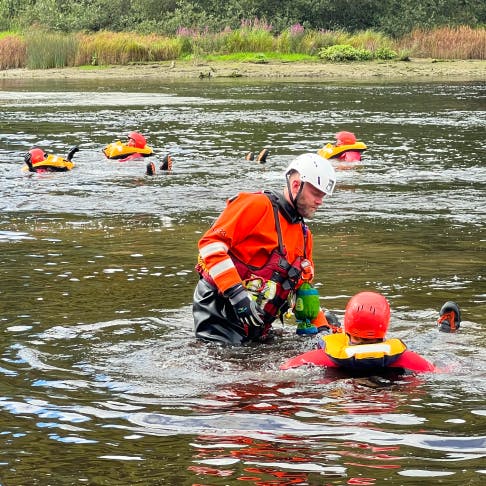
For industrial personnel who work near water but are not expected to enter it intentionally.
Suitable activities can include:
The course covers water hazards, risk assessment, safe systems of work, lifejacket use, accidental immersion, self-rescue and conditional rescue techniques from a safe position.
SWNW is normally appropriate where any entry into the water would be accidental and the organisation’s procedures prohibit intentional entry.
For industrial personnel whose work involves planned entry into shallow or moving water.
Suitable activities can include:
SWIW develops practical competence in water-entry PPE, hydrology, moving-water self-rescue, throwbag and reach techniques, shallow-water movement and controlled wading.
It provides an industrial working capability. It does not designate the employee as a water or flood rescue responder.
For personnel from non-rescue organisations who support operations during flooding.
The Rescue 3 Flood Operations – Foundation course meets the requirements of the DEFRA Flood Rescue Concept of Operations Annex H: Water and Flood Non-Rescue Support Operations Training Module. It also includes the DEFRA Module 1 water and flood awareness syllabus.
The course is intended for workers who may operate near or undertake limited movement in floodwater but are not being assigned a rescue role.
It covers:
FO-F is generally more appropriate than Module 2 where personnel support flood operations but are not part of a rescue organisation.
For selected personnel who respond to water and flood incidents as designated first responders.
The Rescue 3 Swiftwater and Flood First Responder course aligns with DEFRA Module 2: Water and Flood First Responder.
It develops competence in:
Module 2 is not simply a more advanced version of Safe Working Near Water. It prepares an individual for a defined responder role and brings additional organisational responsibilities.
For specialist rescue personnel expected to undertake technical rescues in swiftwater and flood environments.
This level is appropriate for properly equipped and managed rescue teams. It includes in-water rescue, technical rope systems, boat-related techniques and more complex incident response.
Personnel’s actual roleNormally appropriate trainingWork near water with no planned entrySafe Working Near WaterIntentionally enter or wade as part of industrial workSafe Working in WaterSupport flood operations in a non-rescue roleFlood Operations – Foundation/Annex HRespond as a designated water and flood first responderSFR/DEFRA Module 2Undertake specialist swiftwater and flood rescueSRT/DEFRA Module 3
Some clients and asset owners stipulate DEFRA Module 2 as a contractor requirement. Where Module 2 is an explicit contractual requirement, ISAR3 can deliver the corresponding Rescue 3 SFR training.
However, we recommend confirming whether Module 2 is:
This clarification is important because Module 2 prepares personnel for a first-response role. Employers should understand the resulting expectations concerning PPE, rescue equipment, procedures, team arrangements and continuing competence.
Training an individual does not, by itself, create an organisational rescue capability.
DEFRA-aligned competence involves more than attending an initial course.
Module 2 personnel must undertake at least eight hours of recorded continuing professional development each calendar year. This must be delivered over at least two sessions, with an appropriate element undertaken in moving water.
Annex H personnel also require recorded annual development covering relevant awareness outcomes and the donning, doffing and care of water PPE.
Organisations specifying these standards should therefore consider:
ISAR3 can support both initial training and an appropriate ongoing competence programme.
The highest qualification is not automatically the safest or most appropriate qualification.
Training should reflect:
ISAR3 is a Rescue 3 Europe-accredited training provider with extensive experience delivering water-safety and rescue training to industrial organisations, emergency responders and the Environment Agency.
Our instructors can deliver industrial water-safety courses, Annex H-aligned Flood Operations – Foundation training and DEFRA Module 2 and Module 3 responder courses.
If you are unsure which standard applies, send us:
We will provide a clear, role-based recommendation and explain any equipment, procedure and continuing-competence requirements associated with it.